By UK journalist Peter Taylor-Whiffen
“ONE thing about trains,” a famous railwayman once said, “it doesn’t matter where they’re going. What matters is deciding to get on.”
So, we decided to get on. And that’s how Mrs TW and I found ourselves just before midnight in a cramped and confined space in the heart of Bohemia, preparing for bed with a couple of young strangers. As you do.
It had all begun because we couldn’t agree on where to go on a city break. Mrs TW wanted to see Prague, I fancied Budapest. And, typical of the level of the mutual give-and-take compromise that has sustained our marriage these past 30 years, neither of us budged. But fortunately, it turned out we didn’t have to choose at all. We could do both on the same trip – by taking a night train.
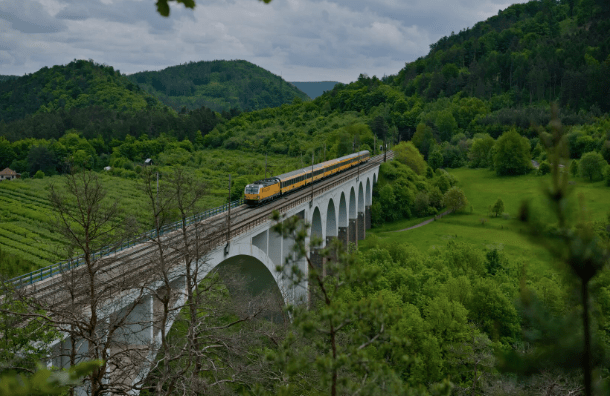
“One of the most comfortable travel options between the capitals of Czechia and Hungary is a RegioJet train,” proclaims the rail company’s website. And you’d want it to be comfortable, for this is a journey that’s 443km (275 miles) long and, thanks to several scheduled long-stay stops in the darkness, lasts a mighty ten-and-a-half hours.
We’d been inspired to book this after watching BBC TV series Race Across The World contestants using overnight travel to save time and the expense of a hotel by sleeping on the move. It seemed a novel and exciting adventure, for overnight trains are somewhat alien to the British, and the only two that do exist in the UK – the Caledonian Sleeper between London and Scotland, and the Night Riviera Sleeper, which links the capital with Cornwall – are monumentally expensive.
But in continental Europe, it’s a different story: overnight trains are so plentiful and connected that if you were minded, you could journey 2,000 miles in the dark all the way from, say, France to eastern Russia, or Belgium down to Turkey.
Having realised Prague to Budapest must be possible, a brief Google search quickly found České Dráhy, the Czech national rail company, offered an overnight service for just £58.12 each to secure a ticket, plus £40 to reserve the couchette – a total of £156.24 which, considering it’s a bed for the night and two countries’ worth of travel, is a pretty good deal. (And incidentally, for comparison, about half the price of the shorter UK journeys.)
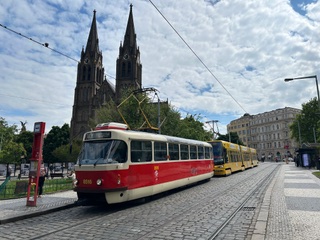
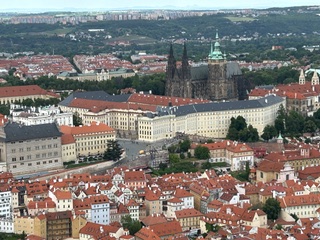

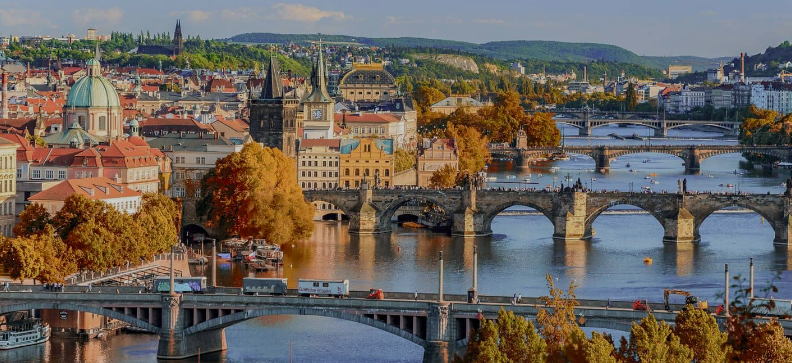
We’d liked Prague. We’d flown from Stansted and enjoyed ambling through its cobbled streets, the warm spring sunshine showing off its pretty, fairytale architecture of Gothic and Baroque towers and turrets. Splendidly, it manages to showcase this history so well by closing off all its major sites to traffic.
Thus we really felt we were stepping back in time exploring the fine town square, crossing the River Vltava on the city’s wonderful 14th century Charles Bridge, or walking up the cobbled hill to the city’s magnificent 1,100-year-old castle. This also houses the medieval St Vitus Cathedral, which depending on your taste is either a majestic collection of worshipful art or overstuffed with over-the-top tacky iconography. (You may be able to guess what I thought.)
It’s a fine city that immerses you in its history. But it is modern too, as evidenced by such things as a cheap, efficient and easy tram and metro network, an excellent choice of restaurants and, curiously, an arresting abundance of shops selling cannabis.
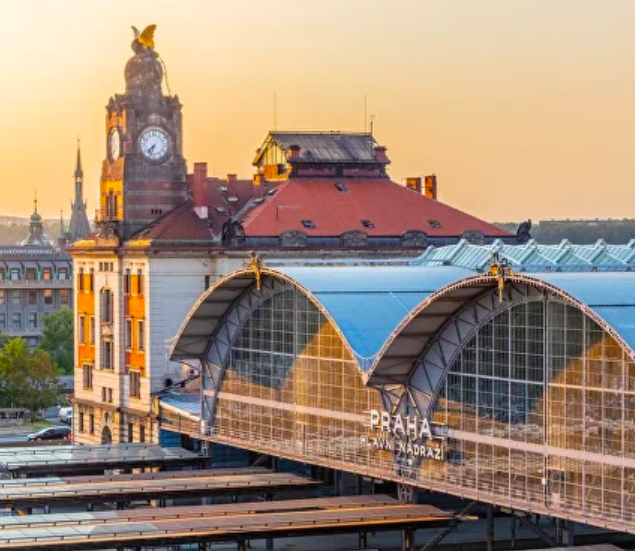
Having spent three days sampling almost all of the above, at 9pm we pitched up at the city’s central station in good time for the 22.01 service to Budapest-Nyugati. They do say it’s better to travel hopefully than to arrive, and indeed our first challenge was increasingly frantically scanning the departure board over the next hour for any sign of the train and hoping we hadn’t missed it.
Anyone who’s seen Race Across The World will know there’s frequently a sense of jeopardy about these things, and if contestants’ transport doesn’t come off they have to improvise by doing something crazy like staying at a local’s house and paying their way by picking up poo at the family llama farm.
So we were relieved when the train did eventually pull in, albeit 30 minutes late, and we and our fellow travellers were soon being herded into the carriage by our conductor, a rotund, cheerfully belligerent, grey-haired man who managed to check us all off on his clipboard by using only gestures.
With his uniform and curt manner, he put me a little in mind of fictional gruff but secretly kind-hearted railwaymen such as the ticket collector on the Polar Express, whose quote begins this piece, or stationmaster Perks from The Railway Children. Sadly our conductor’s impatient finger-snapping seemed to suggest he kept his kind-heartedness very secret indeed.
While the train itself had a sleek, modern, LED-lit exterior, inside it gave off a sense of pure romantic nostalgia, as we walked along the corridor to find our old-fashioned, sliding door compartment. It is possible to book a private room with an actual bed on these trains – unless, like us, you dither so long that these sell out and you end up booked into a four-berth cabin. We therefore fully expected to share, but nevertheless were still a little disappointed to slide back the door to discover we indeed did have company. (As indeed they doubtless were, too.)
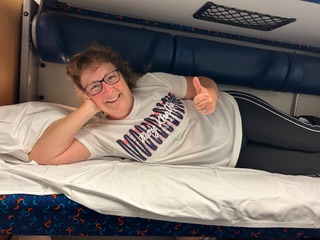
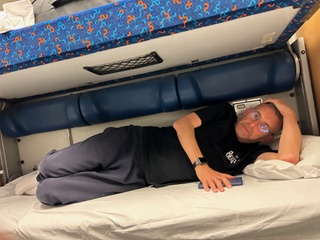
Although a four-berth, the compartment was laid out as two triple-bunk couchettes and our sleeping companions, who were actually a very sweet 20-something couple from New York, had been allocated the bottom bunks. Charles and Amy discreetly busied themselves preparing for sleep and exchanging disarming pleasantries with us while politely trying to ignore a couple of creaky, seized up near-pensioners’ panting and grumbling efforts to manoeuvre themselves into the upper bunks.
And it is an art. You have to climb a steel loft-type ladder, then halfway up step back off and reverse into bed, perching your backside precariously on the edge of what is quite a hard, unyielding bunk and then folding up, twisting and generally contorting the rest of your body into the 18-inch-high sleeping space. And all without a) falling out or b) kicking Charles in the head. (Sorry Charles.) But we got there eventually.
We were all given sheets, a pillow and a bottle of water, which in my case within two minutes of arrival in the bunk had rolled down to one end, fallen through the gap and hit Charles on the head. (Sorry again Charles. He graciously pretended nothing had happened, although that meant less graciously not giving me my water back. Still, having taken so long to get into bed, and at my age, drinking water just before lights out would probably have been a bad idea anyway.)
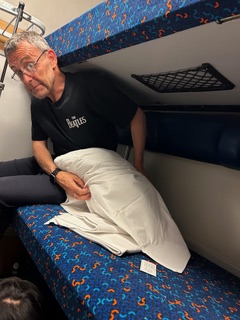
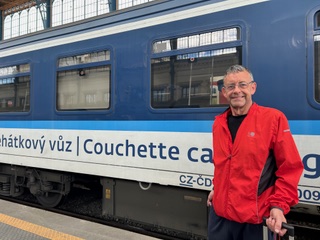
So it wasn’t long after the train started moving that we turned out the light, and we all slept! Make no mistake, this is a practical train designed for slumber – there’s no bar, no trolley service, no in-journey entertainment. Nor even, now I come to think about it, any safety information. There is one aeroplane-style toilet at the end of each carriage. This is built for expedience, not comfort – but go in there knowing that, and you’ll be fine.
The train was largely dark and quiet, and although the bunks were hard, I certainly got more hours’ kip than I would sitting up on a plane. I’m sure all our sleep was a little fitful – at one point Mrs TW, as she frequently does at home, hissed at me to stop snoring, and then saw I was awake and looking out of the window. The snorer was actually Charles but thankfully the hissing didn’t wake him. (Maybe he was concussed by the water bottle.)
The train stopped at a few places overnight, including for a couple of hours in a brightly lit station in mid Slovakia, but our blackout blinds did their job and the night passed relatively comfortably and without incident.
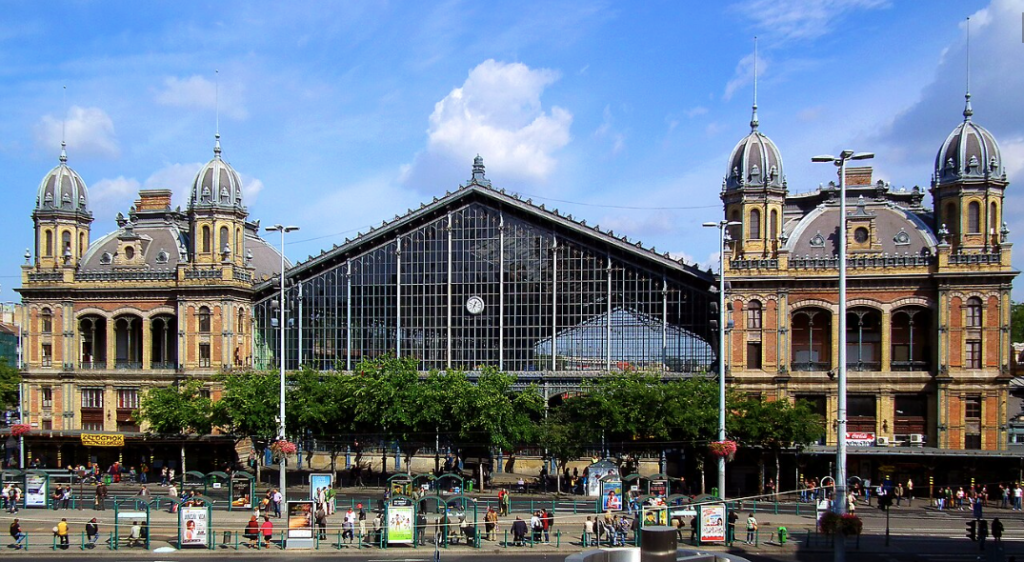
And when we all woke, we were in Hungary and actually, only ten minutes outside Budapest station. There was no announcement of this, and it turned out we didn’t need one, as our friendly conductor rapped sharply on our window, slid the door open and then – I kid you not – wordlessly, frantically, irritatedly started pulling the sheets from under our supine sleepy bodies.
“No tea then?” asked Mrs TW, brightly. Our American companions giggled uncertainly. Captain Sunshine obviously didn’t reply and continued to pull on the sheets, tumbling us out of our beds. (Sorry again Charles, I promise it’s nearly over.) And then barged further in and snapped the beds up against the carriage wall to become seats for its imminent day passengers.
The train website celebrates its “excellent customer service”, by which I think they must mean “perfunctory”, but we were here, we’d slept, and we’d had An Adventure. Which was now, in no uncertain terms, clearly over.
It was fun. And, as we disembarked under the baleful glare of our host, we discovered maybe the very best benefit of the night train. For when you travel this way, youarrive in a new country ready to go. No five mile walks through airports, no passport control, no hour-long wait for your baggage, no hike around arrivals trying to find your transfer bus, no 25-mile journey into the city. Train stations are not airports an hour away from the place where their name claims them to be (I’m looking at you, London Stansted).

We got off our train in Budapest, where at 8.30am on a sunny May morning it was already 21C. We didn’t even have to pass through so much as a ticket barrier, but stepped straight out of the station into the middle of the city and an eight-minute walk later were at our hotel.
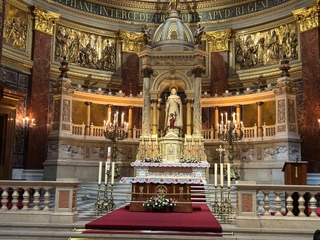
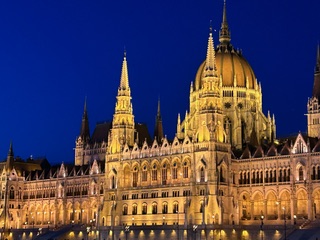
This meant we were relatively refreshed to start exploring immediately and, again, there was much to enjoy. Budapest is quite different from Prague – it too features some spectacular architecture, notably including its own castle and iconic place of worship (the enormous 19th century St Stephen’s Basilica, whose glorifying interior is much more cohesive, tasteful and peaceful than the chaotic ‘look-at-me’ braggadocio of St Vitus).
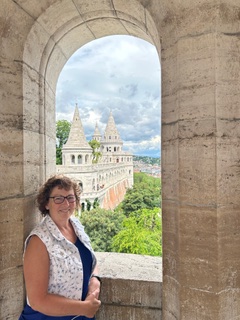
But perhaps an even greater highlight is the beautifully ornate Fisherman’s Bastion, a 140-metre run of 18th century neo-Romanesque turrets sitting high above the Danube and which is the closest thing I’ve seen to a “real” Disney castle.

So the wondrous buildings are there, yet Budapest has a busier, noisier, more bustling feel than Prague. It is more built-up, its main attractions are further apart, and there is more traffic, especially around the historic monuments. Whereas the Czech capital reverently keeps its history separate from modern life, its Hungarian counterpart seems keen to absorb its past into its present and future. For me, Prague looks back, and Budapest points forward.
So which is better? If forced to choose, I’m a traditionalist, so while I loved both cities, I preferred Prague. But as we have seen, happily I didn’t have to choose – thanks to that night train.
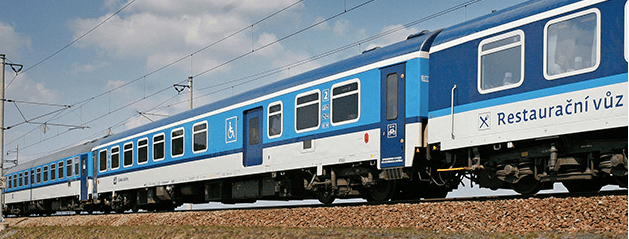
Would we do it again? We’re already planning our next nocturnal train journey. And with so many places we could go, no, it really doesn’t matter where it’s going. Do what we did. Decide to get on.
- Single fare ticket Ryanair flight from London Stansted to Prague (£88.69pp)
- Single fare ticket Ryanair flight from Budapest to London Stansted (£92.53pp).
- Prague-Budapest overnight train ticket with couchette bed in four-berth compartment from České dráhy (https://www.cd.cz/en/ £78.12pp
Like what your read? You can read Peter’s review of Dubai on The Sun Lounger here.
Please follow The Sun Lounger on social media:
https://www.instagram.com/thesunlounger/
https://www.facebook.com/thesunlounger